

The Questions People Ask a Whistlemaker
Misha Somerville answers questions often asked about an unusual and incredible profession.
Here we have drawn together notes from making and playing whistles, gathered over twenty-five years of making them and talking to players. The advice applies to all high and low whistles - including mk whistles (Pro, Kelpie, Midgie and Chameleon) - and to most other quality whistles you are likely to own.
Whistles are among the most robust musical instruments in existence. If you were going to be stuck on a desert island, the instrument you would want to have is a whistle. The strings on a guitar or violin would snap, the reed and pads on a saxophone or clarinet would perish, and a piano would eventually seize up. A well-made whistle will play happily in the tundra, the desert or the rainforest, as well as in a fierce pub session. That said, a few simple habits will keep yours playing at its best for decades.
Not all whistles have tuning slides. Non-tunable whistles carry one real advantage - their simplicity makes them more robust. But for many players a tuning slide is essential, allowing the whistle to be tuned to other instruments or to account for the changes in pitch that come with environment and temperature.
A whistle will take a lot of abuse, but special attention should be paid to the tuning slide - as it is the only moving part on a whistle. There are various tuning slide materials and designs. Instrument makers across all woodwinds have often preferred the acoustic properties of a metal-against-metal slide, but practical considerations sometimes make plastic slides, o-rings, hemp or PTFE (plumber's tape) the preferred choice.
Keep the whistle assembled when not playing. This protects the slide from dropping and prevents the brass from distorting if one piece is dropped on its own. Storing in two parts is possible but riskier - assess for yourself how realistic that is in your household.
Instrument maker's note: most whistles are better kept together because most players use soft cases and sleeves. Any wind instrument which lives in a hard case - a flute, saxophone, clarinet, or for example a Chameleon (which comes with its own hard case) - can be stored with the parts separate. In some ways this makes whistles easier to carry, because they're shorter, but does add a little bulk.
| Slide type | Positives | Negatives |
|---|---|---|
|
Metal on metal (brass, nickel silver, steel) |
Best acoustic coupling - the joint behaves almost as one continuous tube. Precise, decisive feel when tuning. Long service life if cared for. Can be fine-tuned or tightened by squashing the slide slightly. | Requires periodic lubrication. Can seize if neglected or stored wet. Vulnerable to distortion if dropped while separated. |
|
Hemp (waxed thread wrap) |
Traditional, easily user-serviceable. Tension is adjustable. Forgiving of dimensional variation. Self-sealing. | Wears over time and needs occasional rewinding. Slightly less crisp acoustically than metal-on-metal. Friction can vary with humidity. |
|
O-ring (rubber seal in groove) |
No lubrication required. Consistent feel. Tolerant of being stored wet or damp. | Acoustic decoupling at the joint - some players feel it dulls the tone. Slightly more "spongy" feel when adjusting compared to a precision metal fit. |
|
Plastic on metal (Delrin, ABS sleeve) |
Self-lubricating - no grease needed. Will not corrode. Tolerant of neglect. Inexpensive to manufacture. | Less acoustic continuity than metal-on-metal. Plastic can deform over time, particularly if left under tension. Less precise feel. It's plastic - and many instrument makers stick to higher quality materials as a matter of practice. |
|
PTFE tape (plumber's tape wrap) |
Cheap and universally available. Easy to make - no precision fitting required between the slide and sleeve. Quick field repair. Self-lubricating. | Less acoustic continuity than metal-on-metal. Tape wears and needs reapplication periodically. Some players find the appearance less refined than a precision-fitted slide. |
mk whistle tuning slides: Bass C, Low D, Eb, E, F, F# and G use a brass tuning slide. A and above use o-rings (hemp has been used previously).
Open the section below for the slide type on your whistle.
The brass slide on a low whistle is a precision-fitted sleeve. With proper care it will outlast the player; without care it can corrode, distort or seize.
LubricationApply a thin smear of slide grease or cork grease every few months, or whenever the slide starts feeling stiff. A small amount goes a long way - smear a thin film around the inner sleeve and work the slide in and out a few times to distribute. Cork grease is widely available from music shops and online; we also have some in our online shop.
TensioningA brass slide can be tensioned or tightened by very gently squashing the outer sleeve. Detailed instructions here.
Instrument maker's note: the choice of metal matters enormously for a metal-on-metal slide. Aluminium is highly reactive - its surface oxidises the moment it contacts air, and two touching aluminium surfaces will fuse together over time, which makes aluminium a poor choice for a sliding fit. Brass and sterling silver are far less reactive, more inert, and slide cleanly against themselves or other metals without binding. This is why brass slides are the traditional choice across woodwind making, found on saxophones, wooden flutes and mk whistles.
An o-ring slide uses a rubber ring seated in a groove on the inner tube to seal against the outer sleeve. Requires very little maintenance in normal use.
Routine careNone required. The o-ring will not corrode and does not need lubricating.
If the slide feels loose or stickyA very small amount of o-ring lubricant or cork grease applied to the ring itself can restore feel. Avoid petroleum-based greases on rubber as they can cause swelling.
ReplacementRare in normal use. If the o-ring ever splits or hardens, it can be replaced - get in touch and we can supply a fresh one.
A hemp slide is sealed with traditional waxed thread wound around the joint. Hemp gives a different feel from a precision metal fit: slightly more friction, slightly more positive grip when set.
Adjusting tensionIf the slide feels too loose (the head moves under playing pressure) or too tight (you cannot move it without effort), the hemp can be adjusted. Add a turn or two of fresh hemp for a tighter fit; unwind a turn for looser.
When to rewindIf the hemp looks frayed, compressed or no longer holds wax, replace it entirely. The job takes ten minutes once you have done it once. Apply cork grease over the finished hemp wrap to seal and lubricate.
Replacement hemp is available from any band instrument supplier.
A plastic-on-metal slide uses a moulded plastic sleeve fitted over a metal inner tube. It is essentially maintenance-free.
Routine careNone required. Plastic does not need lubricating and will not corrode.
If the slide feels too loosePlastic can deform over time, particularly if the whistle has been left under tension. There is no easy fix at home; for inexpensive whistles a new instrument is usually the practical answer.
If the slide feels too tightA very thin smear of cork grease can help, though some plastic compounds react badly to greases - check with the maker if uncertain.
PTFE tape - the same plumber's thread-sealing tape used for water fittings - wrapped around the inner tube to create a self-lubricating seal. Used by some makers as a deliberate design choice.
ReapplicationWhen the tape wears thin or the slide loses grip, unwrap the old tape and apply a fresh layer. Wind tightly and evenly along the joint surface, trim any excess.
Routine careBeyond reapplication when needed, none required. PTFE is self-lubricating and will not corrode.
A stuck or seized tuning slide is possible, particularly on whistles that have been left assembled without lubrication for a long period, or stored in damp conditions.
The longer a slide is left seized the more difficult it becomes to unseize. In the workshop we have been able to free up and restore slides that have been seized for many years - so don't panic if you have this issue.
1. Penetrating lubricant. Like many seized things, adding a little penetrating lubricant such as WD-40 can help. Apply sparingly - a few short pulses from a spray can, with the nozzle held right against the material so the WD-40 behaves as a liquid rather than a spray, letting gravity carry it into the joint. This usually means having the headpiece pointing downward. Repeat several times over the course of 24 hours so the lubricant has time to penetrate into the joint.
2. Apply twisting force. This can be more difficult than it sounds, because it's hard to hold both the head and the body at the same time. Twisting between two people, or holding the head in a vice, can be useful here. With a vice, if you squash the tube itself to hold it, the tube can deform into an oval shape - which is a much bigger problem to sort out than the stuck slide.
Instead, grip the headpiece at the mouthpiece end, where the fipple block or plug sits. Pad the vice jaws with paper tissue or a folded towel so they don't mark the whistle, and grip the sides of the head so there is no chance of pressing down on or deforming the airway. With the head held this way, both hands are free to twist the body, which adds a useful degree of twisting force.
The trick is to use slightly more force each time - this method lets you add a little more force than you used previously, in controlled steps.
We actually find that the additional oil plus a little extra force sorts out the great majority of tuning slide issues.
In the workshop we have clever ways to grip the whistle body and to apply heat to unstick slides that have been seized for a long time. Feel free to get in touch if you reach the point where you think this is necessary. So far we have never found a slide we couldn't restore.
After every playing session there is condensed moisture in the bore and airway. Left alone, this leaves a residue that builds up over weeks and months and dulls the tone. Some whistle players just let this build up and then do a deep clean every few months, and make that routine work for them. Admittedly, many simply leave it until something seems way off ...and wonder why they didn't do it sooner!
While not strictly necessary, the most thorough cleaning routine is to run a mop through the bore and a pull-through the airway after playing. This takes under a minute, and is certainly what we recommend for high-value whistles like the mk Chameleon - though there is no harm in adopting the same habit for any whistle. The reason it works is that immediately after playing is when everything is moist and easiest to clean. Letting it dry and adhere to surfaces makes it much harder to remove later. We are all familiar with how much more effort it takes to clean dishes after a few hours - or a few days - sitting. The same principle applies here. A quick wipe at the right time is far more effective than a deep clean later.
Add a quick spray of an alcohol-based cleaner to this routine - IPA or methylated spirits. This keeps things clean, sterile, and free from biological growth, which is what causes whistle mouthpieces to start smelling over time. We generally recommend alcohol-based cleaners over water or detergents, because even a small squirt kills germs - this is what hospitals use to sterilise surfaces and equipment.
Instrument maker's note: the main reason we don't recommend washing whistles in water and detergents is that tap water - especially combined with cleaning detergents - can be surprisingly corrosive to metals. The exact chemistry depends on your local water, but for this reason we are careful to avoid normal tap water and household detergents in our Glasgow workshops.
Besides the more widely available alcohol-based cleaners (which work fine), we offer a spray bottle we call Wistol, which comes with our cleaning kits when they are available. The handiest thing about it is probably just the small travel size - it can feasibly live in an instrument case and will last a good long time. Spraying Wistol into the fipple window and cleaning the corners inside the mouthpiece - through the window, with cotton buds - catches exactly the area between what the pull-through and the bore mop reach. It gets into the corners where germs might otherwise build up.
The bore is the main tube of the whistle. The best tool for cleaning it is a woodwind cleaning mop sized for whistle. Our modular cleaning mop has an extendable handle that fits tunable and non-tunable whistles in any key, from high D up to low D and below.
For a tunable whistle, separate the head from the body before cleaning the bore. For non-tunable whistles, run the mop in from the foot end. A few passes through is plenty - you are removing moisture and dust, not scrubbing.
Instrument maker's note: it has always been difficult to find wind instrument mops which fit low whistles. This was the motivation for the mk extendable cleaning mops. One of the key things about these is that the mop heads can be removed for cleaning or replacement.
The airway is the narrow channel inside the mouthpiece that shapes your breath into a column of air against the blade. It is the most important part of the whistle acoustically, and the part that most benefits from periodic cleaning.
Two methods work well:
Folded paperA strip of newspaper or thin paper, folded to match the airway profile, can be pushed gently through after playing. This is a perfectly serviceable field method.
Tapered felt swabOur cleaning kit includes tapered felt pull-throughs designed specifically for the mk airway profile. Because the pull-through is tapered, as the wider section is pulled through it tightens up in the airway and gets into all the corners.
How often? For regular players, once every week or two. For occasional players, once a month or whenever the tone starts to feel less responsive. Cleaning the airway can give a whistle a noticeable new lease of life.
Important: we use paper or felt to clean the airway because they don't damage it, but do provide a light scrubbing action and an absorbent surface. The blade edge at the far end of the airway is precision-machined and any damage to it will affect the tone permanently, so for routine cleaning stick to soft materials. (For removing a specific obstruction, see Airway Obstructions.)
The exterior of the whistle picks up oils, fingerprints and the inevitable residue of a real working life. Wipe it down with a soft cloth or tissue. For a more thorough clean, a tissue dampened with methylated spirits or an alcohol-based cleaner removes oils without damaging the finish.
Our cleaning kit includes Wistol, a cleaning and sterilising solution formulated for woodwind instruments. Avoid household chemical cleaners - many contain abrasives or solvents that can dull anodised finishes or attack the brass tuning slide.
Clogging is quite common in whistles. The key characteristic is that the whistle will play beautifully at first, but the tone will start to break up - usually after 30 to 60 seconds of playing. If you are in any doubt, you can send us a recording and we can diagnose it.
Instrument maker's note: anything that is a permanent feature of the tone, rather than intermittent or delayed, is not due to clogging - it is more likely to be something permanently stuck in the airway (see Airway Obstructions below).
How prevalent clogging is in any given whistle depends on how the mouthpiece is engineered to deal with the moisture in our breath. Some whistles are excellent at moving that moisture away from the airway, so it never interrupts the airflow through it.
Moisture is present in everyone's breath to varying degrees - some people naturally blow with more moisture than others. Sometimes a player's technique develops over time and the amount of moisture in their breath reduces; sometimes it doesn't. For those players, the most important property of a whistle becomes whether it will clog or not when they play.
Even mk whistles, which are designed to be almost completely anti-clogging, do occasionally clog during the period after they are new and before they have been played in. This isn't game over - as the whistle plays in, the clogging magically starts to disappear ...until it's gone completely! The trouble is that during this play-in time, if the instrument is clogging it can be quite uninspiring to play. For this reason we provide an anti-condense solution, which accelerates the play-in time for whistles and is worth trying on any whistle you are having clogging issues with. Instructions for using the anti-condense solution are here.
Instrument maker's note: why does the play-in time, or applying anti-condense, change things? It comes down to whether the airway surface is hydrophobic or hydrophilic. On a hydrophobic surface, moisture forms as discrete droplets - which is exactly what disrupts airflow and causes clogging. On a hydrophilic surface, the same moisture spreads out as a thin even layer instead. Playing the whistle in gradually changes the airway surface to be hydrophilic; anti-condense solution simply accelerates that change.
If a whistle's tone is consistently off from the moment you start playing - rather than degrading after a minute or so - the cause is usually something other than clogging. Most often it is a small obstruction sitting in the airway: a piece of fluff, a fragment of paper from a previous airway clean, or dust accumulated in storage.
It is relatively easy to check. Just look down through the airway. A light held behind the headpiece, or shining through the window, helps to accentuate any obstructions.
If you spot something, the best way to remove it is usually with a needle. Keep the needle parallel to the airway - this stops the point from damaging the airway itself. You also don't want to push the point all the way through to the blade - this isn't necessary, and you risk damaging it.
If the tone is still off after the airway is clear, get in touch. We can diagnose remotely from a recording, and if the whistle does need a workshop service we'd rather see it than have it damaged in an attempt to fix it.
Other than with respect to clogging, whistles tend not to need much play-in time. However, you may find that after a few weeks or months the whistle becomes more stable - particularly in the moments as you pick it up to start playing.
Players have often developed their own techniques for encouraging this stability. A classic is to clear the airway by covering the window and giving a short sharp breath. This delivers a pulse or burst of air which dislodges any moisture droplet sitting in the airway - droplets that often form when a cold instrument meets warm breath and condensation occurs. Playing the whistle will often dislodge the droplet anyway by pushing it through the airway, but this can take a moment longer. The pulsed-breath technique is how many whistle players encourage that stability from the off, before the whistle is warm.
In fact, players have often subconsciously developed their own warm-up routine for a whistle. Typically this is a combination of long breaths through the covered window (which are more effective at warming the headpiece) and short breaths (which keep any moisture droplets moving through the airway).
With high whistles it can be possible to push the whistle far enough into your mouth that your lips cover the window, at which point either short or long breaths can be used.
Whistles are made from a range of materials, each with its own properties and care considerations. The body of most mk whistles is anodised aluminium and tuning slides on larger keys are brass. Below is a broader look at the materials you'll encounter across whistles in general.
The anodised body is hard, corrosion-resistant and stable. It does not need polishing or special treatment. Wipe with a soft cloth; for stubborn marks use a tissue with methylated spirits or alcohol cleaner.
Bare aluminium will corrode at the surface, but the corrosion isn't all bad - it actually forms a protective oxide layer that prevents deeper damage. Polished or raw aluminium whistles will dull over time as this layer develops. The surface can be re-polished if you prefer the bright look, but in normal use the natural oxide is the whistle's own form of protection.
While that oxidation isn't all bad as a surface effect, it does mean that aluminium tuning slides will fuse together very readily. For this reason, an aluminium whistle with a tuning slide will often have the slide itself made from a different material - much like a wooden flute, where the slide is a metal sleeve inset into the wooden body.
Brass can be an interesting material for making whistles, if a little heavy. It does carry one particular advantage over reactive metals like aluminium - the tuning slide can be made from the same material as the body of the whistle, since brass surfaces don't fuse against each other the way aluminium does.
Brass whistles will corrode at the surface, but often the patina has a weathered, characterful look that most owners choose to leave alone. It is possible to re-polish a brass whistle to restore the original look. Be aware though that commonly available brass polishes (such as Brasso) actually achieve their effect partly by filling the surface texture of the brass rather than removing it - so the finish you get isn't quite what came off the workshop floor. Properly polishing a brass whistle takes specialist equipment and a skilled hand.
High whistles are often called tin whistles, after all. Tin is thin and quite malleable, which has historically made it a great material for whistle making. The slight difficulty is that it doesn't have any thickness - and it is the material's thickness that provides the depth needed to cut an airway into the head. Some makers have found ways to add separate blocks that form an airway, but typically these whistles aren't as consistent as those formed from thicker metals like aluminium.
A small number of makers produce carbon fibre whistles. The material is light, dimensionally stable, won't corrode, and doesn't patina. The acoustic character is a matter of taste - some players love the lightness, others prefer the weight and feel of metal.
Care is straightforward - wipe with a soft cloth, avoid abrasives. The one thing to bear in mind is that scratches and surface damage cannot be polished out the way they can on metal. Tuning slides on carbon fibre whistles are typically metal sleeves bonded into the body, since you can't make a sliding fit between two carbon fibre surfaces.
Wooden whistles have a long tradition - boxwood, African blackwood, cocuswood and similar dense hardwoods have all been used. Some modern makers still produce wooden whistles, often as boutique pieces. The acoustic character tends to be warmer and slightly darker than metal, which is part of the appeal, particularly for high whistles.
Care is genuinely different from a metal whistle:
No alcohol cleanersMethylated spirits, IPA and similar will strip the wood of its protective oils. Wipe the bore with a dry mop after playing, and stick to dry materials.
Oil the bore periodicallyBore oil or a light food-safe oil such as almond oil keeps the wood stable. How often depends on the wood and the climate - typically every few months for normal use.
Watch for humidity changesWood expands and contracts with moisture in the air. Sudden changes - taking a cold whistle into a warm room, or playing a dry instrument hard for the first time after storage - can cause cracking. Acclimatise the whistle to its environment before playing, and warm up gradually.
Whistles are forgiving instruments to store and travel with, but a few principles will keep yours in good shape over years and decades.
Store the whistle assembled, dry, and in a place where it will not be sat on. A whistle bag, a flute case, or a dedicated drawer all work well. The main things to avoid are: storing it wet (encourages corrosion at the slide), storing it where temperature swings are extreme (radiators, conservatories, car interiors), and storing loose objects on top of it.
If you have just finished playing, leave the whistle out on a stand or table for an hour to fully dry before putting it away.
Many players leave a whistle out somewhere visible as a cue to pick it up and play. Across a kitchen counter, on a bookshelf, beside the sofa - having an instrument in eye-line is one of the most effective ways to make sure you actually play it. As long as it's somewhere stable and not in direct sun or near a heat source, this is genuinely a good thing to do.
Whistles travel well. A padded sleeve or hard tube case protects against knocks; for low whistles a dedicated whistle bag with a stiffened panel is worth the modest cost. As hand luggage, whistles pose no issues with airport security in our experience - they are clearly recognisable as musical instruments.
Whistles cope with outdoor playing better than almost any other instrument. Sea spray, rain, cold weather, dusty stages - all manageable. The key is what you do afterwards: separate the slide, dry both surfaces, re-grease, and store properly. A quick clean after a damp session prevents the corrosion and binding that long-term neglect would cause.
Sand is one outdoor hazard worth singling out. A grain or two in the airway will dull the tone, and on a windy beach it doesn't take much to find its way in. If you've been playing somewhere sandy, it's worth a quick check down the airway against the light - and a pull-through if anything has settled in there. The same goes for fine grit picked up from busking spots, festivals or dusty trails.
Most whistle care is something you can do at the kitchen table. Hopefully this guide has been useful. We also have a library of articles and videos on our YouTube channel. For anything else, please do get in touch.

Misha Somerville answers questions often asked about an unusual and incredible profession.

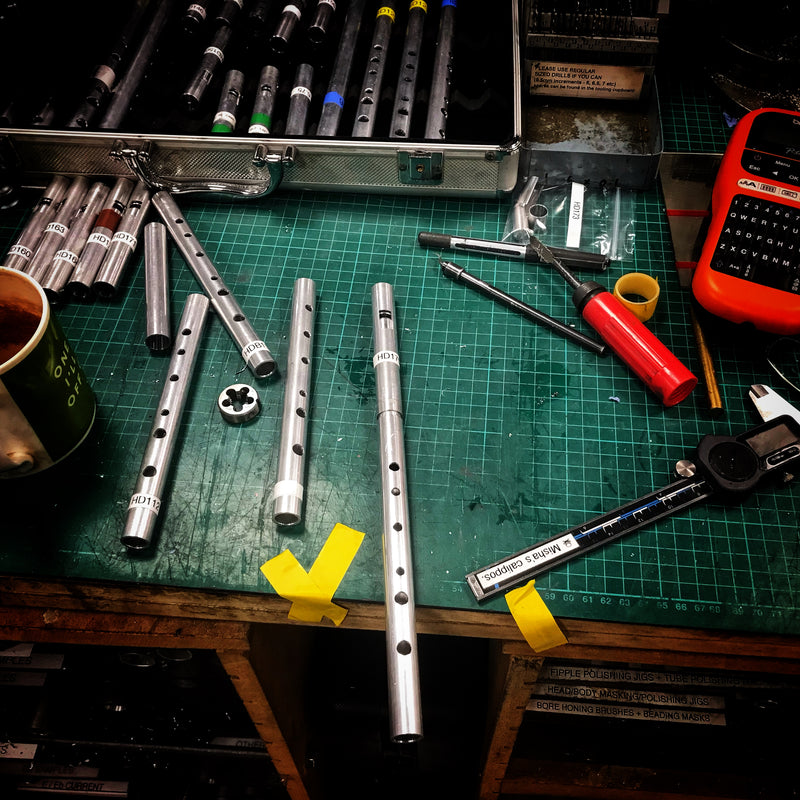
Old oily machines and state-of-the-art technology join forces in the mk workshops.
Long term MK-er Liam Hickson asks the questions he wants to ask after 5 years of anticipation, waiting for the mk Midgie High D Whistle.

