


Developing a chromatic whistle of sorts was probably why I started making whistles in the first place. Trying to play a standard 6-hole whistle chromatically, while doable to some extent, has always been pretty awkward, for me at least, and others also seem to have long journeys in chromatic whistledom - an indicator of the commitment required to master workarounds that work to a greater or lesser extent - some work well, and others not, even after years of practice. This is not to take anything away from those developments, tone-hole layouts, and cross fingerings, but is to offer an alternative. Once you've learned it, the cross fingerings and workarounds aren't something you go back to - there isn't a circumstance where they offer a better option, but only a knowledge of both systems qualifies you to make that judgement.
In fact, any key system on any woodwind is awkward to some degree in one way or another. The main reason for this is an inherent difficulty for humans in playing all 12 notes of a chromatic scale - because we only typically have 10 fingers. Purely by chance, human and musical evolution has not favoured wind instrument makers and players, but it has led to many creative solutions and spawned new musical genres and whacky ideas along the way.
In the long development of woodwind instruments, keys and levers were eventually added to make it possible to play 12 notes with ten fingers. This was not the only solution by any means - harmonics and over-tones, cross fingerings, and double holes (as on the recorder) have also contributed, and resonated in certain cultures and times. But keys and levers became the most commonly used technology, and the mechanism itself was highly innovative in its day. Although this mechanical technology could no longer be classed as innovative in itself, the tone-hole layout, lever patterns, and linkages have a million different possibilities and present much opportunity for fresh ideas.
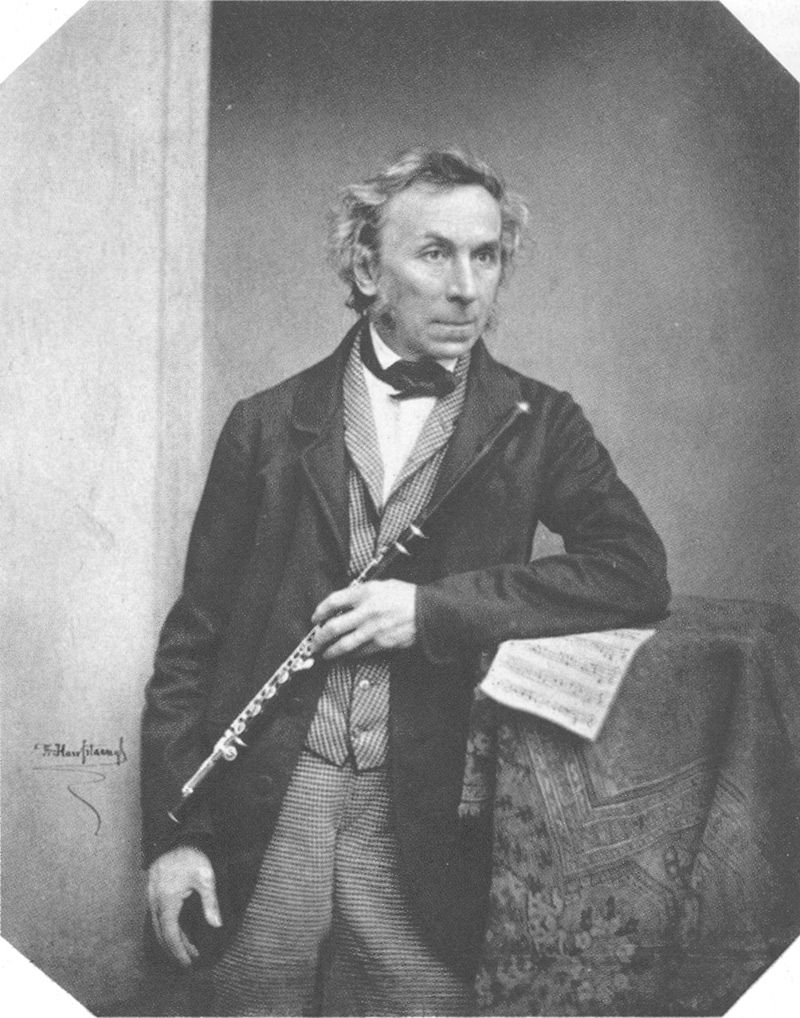
By some measures, the 'ultimate' key system was designed by the gifted flute maker and player Theobald Boehm. This system, which has become the default on saxophones, flutes, and clarinets, was a masterpiece of mechanical ingenuity, designed at the height of the industrial revolution in the 1830s. Boehm's system was a bold, brilliant, and highly technical arrangement of levers that intertwined and could be opened in various combinations to play the additional notes of the chromatic scale and greatly extend the capabilities of the instrument.

But several things had been forfeited in the design. Every hole was now covered with a pad and pad-cup and attached lever, so the finger no longer had contact with the tone-hole on any of the notes. This, in a way, pushed the music into more and more technical realms. The flute, clarinet, and oboe were adopted in classical music and music schools across Europe. But the Boehm key system never gained quite the same traction in folk and world music. This was nothing to do with the modernity of it - the accordion demonstrates how a technical and 'modern' design can be co-opted into cultures worldwide, from Uzbekistan to Scotland.

While Boehm's system was highly successful in some genres, it was not in others - and for this reason, the simple system flute, which actually pre-dated Boehm's, has remained not just alive but more widely used in folk traditions and 'authentic' cultures around the world. While brilliant in its ways, the simple system also has its limitations - some of the hand movements required to activate keys and notes have proved awkward, and so additional key-work was added to offer musicians alternative ways to reach the same notes depending on what the adjacent notes might be. This does not take away from the brilliance of the design, but, as with Boehm's, a different set of positives and negatives emerged.
These two systems are not the only key systems by any means. Many others have been proposed and are in use, but the great majority are variations of these two.
Looking for Another Way
When in 2004 I started looking at key systems to go on a whistle, I wondered if there might be an alternative to these two systems. When I started sketching my early designs, I concentrated on simplifying and reducing the number of elements in the Boehm system, while keeping the tone-holes open and using some of the clever ways the finger patterns made use of note fingerings like F XXXOXO and F# XXXXOO through mechanical linkages. These never made it off the drawing board. There was no reason a Boehm or simple key system couldn't be put on a whistle, but I just didn't see the point - those systems were great at what they were doing, and it didn't seem right for the simple form of the whistle or the music that is played on it.
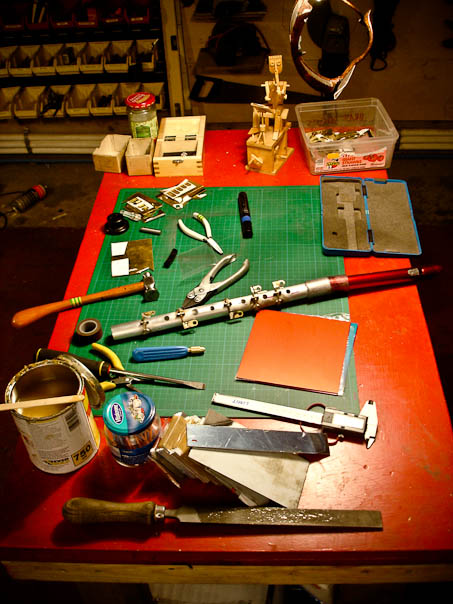
Two years later, I was experimenting with a completely different approach - something that did make it off the drawing board and into a basic prototype, to prove the concept or not. This adopted the idea that the flat fingering on the piper's grip, as often used on a low D, left the possibility of activating an additional note with the tips of the fingers. The geometry was hideously difficult to get right, and it produced a working prototype of sorts after an inordinate amount of time.
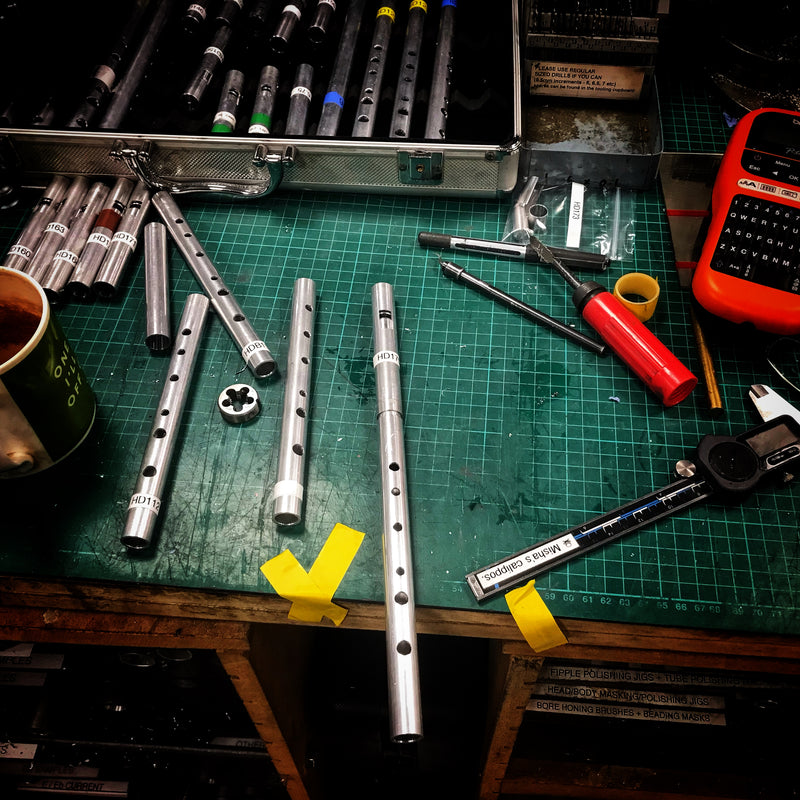
There were several technical difficulties to solve along the way. Classical flutes and saxophones, being made of ferrous metals, allow key-work to be easily soldered on. Wooden flutes, oboes, and clarinets allow pivot blocks to be used or key posts screwed into the thickness of the wood. Aluminium, as typically used on low whistles, was awkward to weld accurately and difficult to drill and tap given its thickness. So I developed a system of screwing a micro screw from inside the bore of the instrument into the keywork. After making a specialist tool to place these screws deep into the body of the instrument, it worked quite well.
But the design and prototype were poor, to say the least. There were several difficulties, one being that it was so sensitive to the length of the player's fingers that every instrument would need to be made specifically for the player - something entirely unfeasible given how long it had taken to make one. The key and tone-hole at each position were also extremely difficult to activate at the same time. This design had taken so much energy to realise that, along with the other whistles being made in the workshop for customers around the world, I became quite ill with Chronic Fatigue in the winter of 2008.
For two years, I was severely debilitated by the illness. Hope of making musical instruments again, or indeed leading any kind of normal life, seemed extremely unlikely. Chronic Fatigue is a pervasive illness that is incredibly difficult to recover from because so little is known about it, and the normal scientific and medical approach of considering physical and mental health separately is largely useless in dealing with an illness that spans both, through the body-mind. Thankfully, with some help from very clever therapists working out-with the established medical practices, I was able to crack the code and recover - although this ultimately would take ten years.
When I returned to the workshop, the masterful designer and mathematician Brian Loudon and I collaborated, looking at the design of the keywork itself in case we came upon a new mechanism for the keys. We dispensed with a pivot, using keywork floating on leaf springs. We open-sourced this through the mk website for some time, to let people know what we were doing and to see if collaboratively we could unearth something exciting. It produced some interesting ideas, which we may still incorporate going forward, but it left the core keywork layout unsolved.
Around 2018, another incredibly talented designer, Roy Shearer, came to work at the mk workshop and we pushed forward the design challenges of the time. We stripped it all right back to only the essential elements. We added the G# and Eb keys, which feature on nearly all keywork - simple and Boehm included. Then we came to the conundrum of the Bb and F notes, which had been tormenting me for almost two decades.
Originally we were working with a simple cantilever key that was open when pressed under the thumb. This caused additional challenges, because the thumbs (on which the instrument rests) would have to be lifted off until a Bb or F was played. So the instrument would need to be supported some other way.
We then moved the pivot point up the instrument, so that the thumb would sit on the key in the closed position until the Bb or F was to be played. In a way this is similar to the Boehm mechanism, but in a slightly different form. Doing the same with the F note then left all six tone-holes, as on any whistle, untouched. The original architecture and tone-hole layout of the whistle had been maintained, but the additional keys were there to be used should the need arise.
As soon as this was born, it was immediately obvious to me that the 20-year conception was over - the Chameleon had been born. At once it was so beautifully simple, elegant and intuitive. Still, when you look at it, its simplicity belies its capability.

In a way the mechanism aesthetics and design didn't matter once the core problem had been solved. Roy and I worked to produce two versions - one from silver steel (which we only ever made in very small numbers, called the mk Toob) and one using more radical 3D metal printing technology. While testing some of these early instruments, I was regularly picking up and covering the Bb and F holes before the keys were placed on the body. It started to become obvious that it might actually be possible to cover the back tone-holes without the need for any keywork at all, if an adapted hand position was used. This became the more extreme 2-legged Chameleon, with the original Bb and F keyed Chameleon becoming the 4-legged Chameleon.

It has certainly been a long, at times arduous, but rewarding journey. As each month goes by we receive messages from people who have received a Chameleon, and for whom it has re-invigorated their music and even rebalanced their life. I will say, despite the turmoil it caused for a long period, it has done this for my music and my life.




0 comments