

The Questions People Ask a Whistlemaker
Misha Somerville answers questions often asked about an unusual and incredible profession.
Every key. Still your whistle.
Play in any key on the low D you already know - and finally ornament the notes you spent years learning to fudge.
mk Chameleon: from the same bench as the mk Pro, Kelpie and Midgie.
Made in Scotland

A whistle in D. Another in C. One in B♭. The E♭ you bought for a single tune and the A you grab when the fiddlers go there. You carry them to every session and swap mid-set to play in a different key. Everyone who plays seriously ends up with the roll of whistles - hunting the right one for each tune, the only one in the session who has to change instrument to follow the key.
And you know the other thing. The notes you've fudged and found a way around, year after year, but never quite trusted enough to linger on. Often it's just one note standing between you and a whole tune - an F natural, a G sharp - one note you've chased through years, even decades: closer and closer, good enough to fudge but never quite good enough.
Be honest about it, because you already know the truth in your hands. To play in every key you need notes a plain whistle hasn't got, and you've spent years working round the gap. Some of them you can half-hole or cross-finger well enough to get by in a quick run - you're past the note before the ear or the breath can catch the wobble.
But that workaround gives itself away two ways, opposite ways. Ask the same fingering to move at speed through a tune in a less friendly key and it won't stay clean or in tune - it works at a crawl and falls apart the moment the tempo lifts. And the notes that a quick run doesn't catch out, the slow air will: held bare and exposed, with nowhere to hide, a note that was only ever half there - wavers, thins, cracks. Fast or slow, the fudge shows - it just shows differently.
And there's a second catch, perhaps the worse of the two. Even when you do coax one of those notes close to true, you can't do anything with it. You can't throw a roll, cut or tap it - your fingers are busy holding the fudge together, and the note's too unsteady to take an ornament. And to a whistler, ornamentation is what makes a whistle a whistle.
A maker spends years perfecting the tone of every plain note - the depth, weight, timbre, balance - and a single half-formed note murders the lot. Every note deserves that care - even the ones we used to fudge.
So those are the notes the Chameleon gives proper holes and keys to - E♭, F natural, G sharp and B♭. Real notes, not workarounds.
One note is left alone, by design. C natural still cross-fingers and half-holes, the way it always has - the back thumb position goes to B♭, the note that needed it more, and the hand only has so many fingers. C natural was the most usable of the old workarounds, so it stays as it was. No pretending otherwise.
"It's a whole new world of whistle playing to have those incidentals be so pure and strong and consistent. No more half-holes and fluffed notes, just a reliable full sweet range." drew m, Verified Buyer
Same fingering. Same voice. Nothing to relearn.
Pick up a Chameleon and play your tunes the way you always have. The other notes are only there when you reach for them. When the session lifts into A major, the G sharp sits solid under your finger. E major - no problem. D minor - fine. You stay in step with the fiddle without missing a beat, instead of reaching for another whistle.
You were always right to reach for those notes. Now you don't have to fight the instrument to get them. In a slow air, the note you used to fudge sits there strong and true, not thin and wavering. For the first time it's a real note, not a fudge held together by busy fingers - steady enough now to take an ornament, where before it was too unsteady to decorate at all.
The whistle didn't evolve from anything. It is one of the oldest instruments there is - its own voice, its own music, an unbroken living line that runs straight into the tune you'll play tonight. It has always been its own thing, and it has never stopped growing.
The Chameleon is the next step in that line - a humble one. The voice is the voice you already play with. The extra notes grow out of the whistle. It looks like a whistle, plays like a whistle and sounds like a whistle, because that is exactly what it is. A fiddle doesn't stop being a fiddle because it can play an E♭.
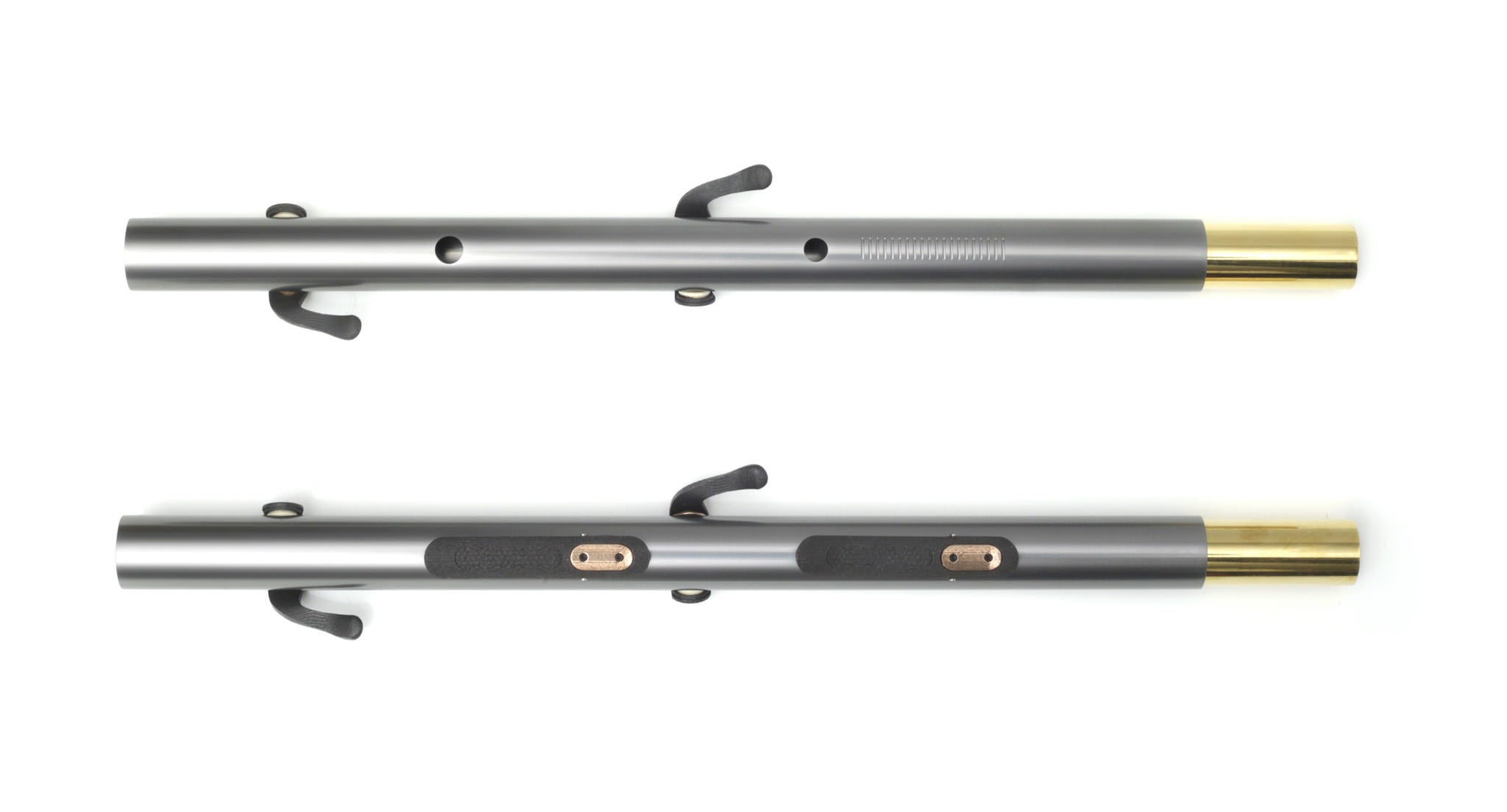
Play the Chameleon as a plain six-hole whistle and it is one - the extra notes stay silent until you reach for them.
On the four-legged Chameleon the keys fall where your hands already sit. The B♭ and F natural are held closed by the natural balance of the whistle on your thumbs and a light magnetic spring - lift a thumb and the note is there - so it costs no conscious effort and no tension. You play it much as you always have.
The two-legged version trades those keys for thumb-holes: it asks an altered grip and a playing-in time, but gives you direct contact with the tone holes in return, for the freest ornamentation. It comes with a polished stopper for the back holes, so you can close them off and play it plain whenever you like.
Either way, the whistle under your fingers is the one you already know. You lose nothing. You were right to love the simplicity - it's all still here. Unassuming, but quietly capable.
"Astonishing how refined and uncomplicated the key system is. The keys fall right under my fingers with no special hand position, and the action is unbelievably smooth." Sean C, Verified Buyer
The one move a cautious buyer trusts. Hear the slow air held on a strong G sharp - the note you used to fudge, now solid enough to stand on, then ornamented like any other.
The keys you play are cast in solid brass, then blackened. The earliest versions were 3D-printed - that was how the design was developed and proven - but nothing printed survives into the instrument in your hands, and there is no plastic anywhere on it, just like any quality woodwind.
Mounting keywork on a whistle was the real problem to solve. A keyed wooden flute has a thick wooden wall to anchor its keys into; an aluminium whistle has a fraction of that thickness, and aluminium doesn't take easily to welding or heat-joining. So the keys sit on a system of custom micro screws and interlocking footprints, developed in the workshop to carry keywork on a thin metal wall. The pivot screws, too, are made to live on the Chameleon alone. With one exception - the pads, kept standard so they can be replaced - every part is custom-made and refined: each to do its task, all to work as one under your fingers.
Premium materials and premium processes throughout - and still a whistle.

"The beauty of this whistle is that you can still half-hole, bend, and slide into notes - but now you have the option of playing a pure-sounding accidental. An aesthetically beautiful sounding whistle with a visually stunning appearance." Doug Cowan, Verified Buyer
Here is what it does, and what it doesn't. A low D is still a low D - it plays in a low D's range, not a high D's or a low C's, and isn't meant to. But within that range it plays in any key. When a tune moves into a key a plain D couldn't follow, you don't reach for another whistle - the notes are already under your fingers.
And your other whistles don't go anywhere. The ones you love for their own voice are still there to be played - you'll reach for them by choice now, not because a tune changed key.
The Chameleon will widen your musical world. Be clear-eyed about one thing, though. Your own tunes transfer from the first day - but it's a low D played with keys, and the limits are worth knowing: a fast chromatic run, or quick triplets on a keyed note, ask more of the mechanism and more of you than an everyday passage does.
Occasional accidentals and playing in a new key come easily. Full fluency in every key, ornaments and all, comes the way fluency always comes - with time at the instrument.
The Chameleon is priced as what it is: a hand-made chromatic instrument, built from premium materials by a working whistle shop. Set it against the bag of single-key whistles, against the years spent chasing notes that almost happened, against a keyed wooden flute - or any flute, clarinet or saxophone of the same standard of making - and the figure reads true to the humble whistle.
And you don't take our word for it. Every Chameleon carries an mk lifetime guarantee and a 30-day try-at-home policy: play it in your own room, in your own session, and if it isn't for you, send it back.
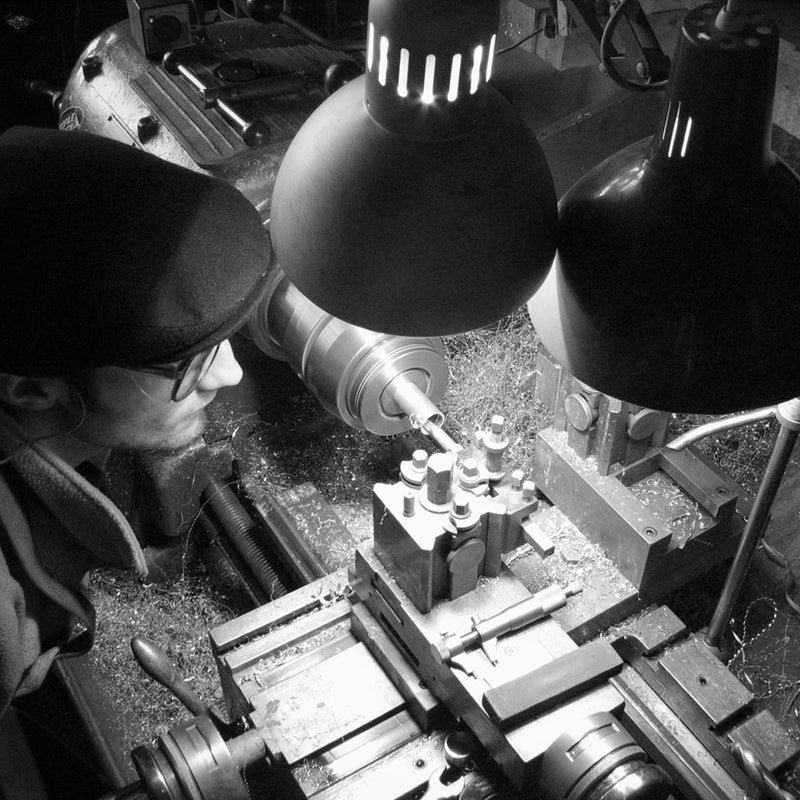
Misha Somerville answers questions often asked about an unusual and incredible profession.

Old oily machines and state-of-the-art technology join forces in the mk workshops.
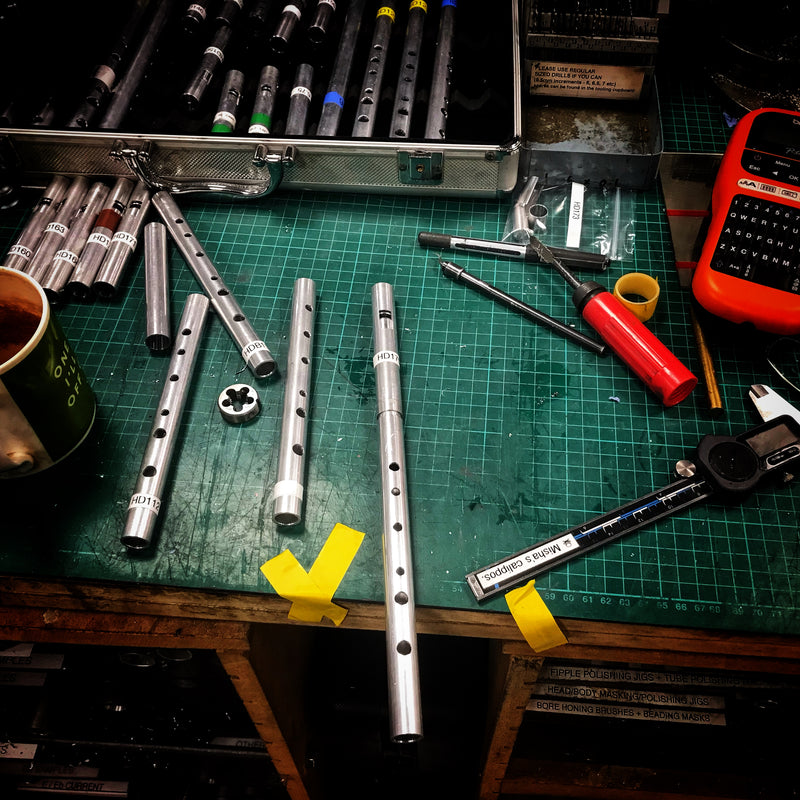
Long term MK-er Liam Hickson asks the questions he wants to ask after 5 years of anticipation, waiting for the mk Midgie High D Whistle.

